What’s Included in a Paella Class in Barcelona?
If you come looking to “make a paella” and leave with a nice photo, you’ll enjoy it. But if you come ready to truly learn — what you learn in a paella class — you’ll take home tools that work at home, at events and in professional kitchens: fire control, rice management, team setup and the blessed technique of the socarrat. There’s no smoke-and-mirrors here: there’s method, practice and a little controlled chaos so the learning actually sticks. Also, if you’re an organizer, I’ll explain how to integrate the activity into a corporate event and how to measure results beyond the office meme.
What you will learn and how the experience is organized
In this article I’ll tell you plainly what a paella class includes, what you learn in a paella class, and how a paella experience works from booking to leaving with the recipe and the group photo. You’ll find:
- The logistical elements a professional class always includes (equipment, safety, materials).
- Theory and practice about rice, stock, proteins and balancing flavors.
- Concrete techniques: making the sofrito, managing hot and cool zones on a wide pan, and achieving socarrat without burning anything.
- Formats for groups: from an intimate friends’ session to a paella competition for one hundred people on a terrace.
- How we design the coffee break and why those pauses improve rhythm and the overall experience.
- Food-safety protocols and sustainability measures we actually use.
- Practical templates: a run-sheet, an organizer’s checklist, and a jury rubric for team-building.
This isn’t just an index; it’s a promise. Each point will be developed with practical examples, simulated cases and tips you can use tomorrow. If you’re responsible for events, I’ll give you concrete criteria to evaluate providers. If you’re coming to cook, I’ll give you actionable tricks so your next paella at home works. By the end you’ll have a clear decision checklist and a call to action to book if you want to go from “I’d like” to “I did it.”
Full development: everything included in a paella class in Barcelona
Setting, equipment, ingredients and technique
First, the basics that matter: venue and equipment set the whole experience. A paella class run professionally always — I repeat, always — includes paella pans sized to the number of participants, calibrated burners or braseros (depending on the format), utensils, aprons, serving material and a clear safety plan. It’s not glam — it’s common sense: you don’t want to improvise a gas setup in an office with no permits.
About ingredients: you’ll learn why Bomba rice is the benchmark (it soaks up more liquid and handles timing better), but also why there are alternatives (Senia, Albufera) and how to adjust the rice-to-water ratio according to the rice type and pan size. In class we teach you to prepare two kinds of stock (quick and reduced), how to choose fresh proteins (what to ask for at the fishmonger) and how to build real vegan paellas — not bland substitutions — using mushrooms, roasted peppers and concentrated stocks.
Technique is the heart. You will learn:
- The sofrito by stages: temperature, color and aroma as indicators — not a timer.
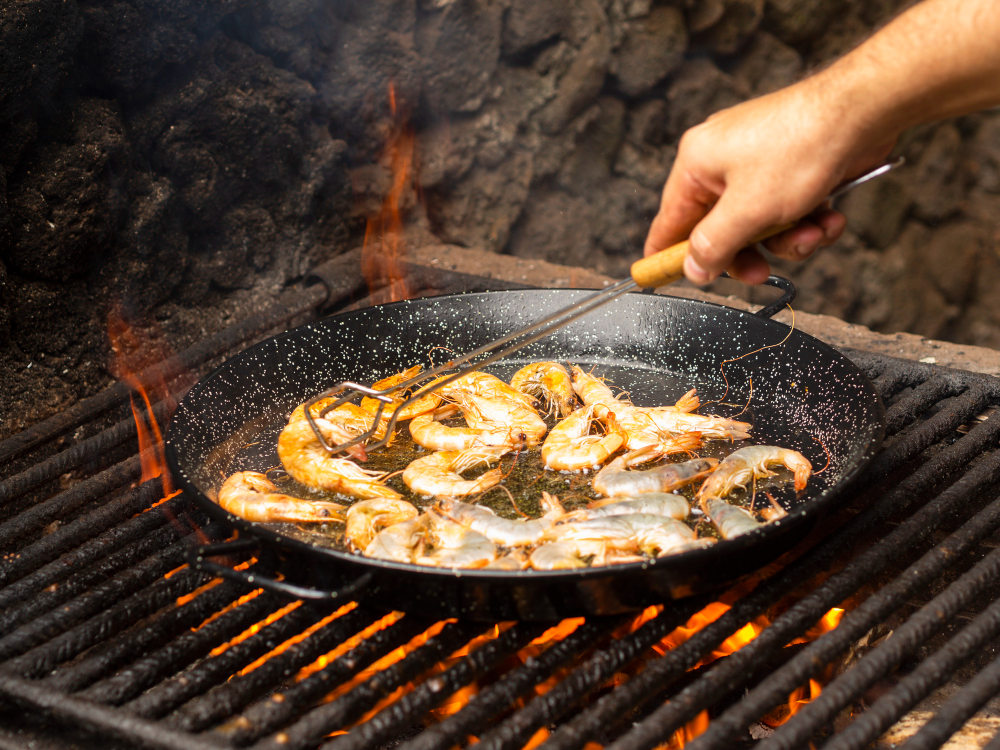
- Heat control on a wide paella pan: identify hot and cool zones and how to compensate.
- Socarrat development: when to seek it, how to provoke it and when to stop so you don’t ruin the dish.
All of this is practiced live. Watching isn’t enough: every team cooks their own paella and receives immediate correction. That real-time feedback is the difference between a one-off show and true transferable learning.
How the class runs from arrival to tasting
I’ll give you a clear timeline, because order matters and if you’re a planner this will be useful.
- Arrival and welcome (10–15 minutes): quick instructor intro, event goals and role assignment. We also check the allergy/diet form.
- Practical demonstration (20–30 minutes): the instructor cooks a full paella live, pointing out critical moments: sofrito, stock, when to add rice and how to modulate the flame.
- Mise en place and team setup (15 minutes): each team preps ingredients and organizes the station. Organization in the kitchen is a useful skill.
- Team cooking (45–70 minutes): hands-on. Instructors rotate, correct and fine-tune.
- Finishing and resting for the socarrat (10–15 minutes): the “magic moment” when the paella rests and the socarrat forms.
- Tasting, scoring and feedback (30 minutes): tasting, scoring (if competitive) and a debrief with takeaways.
- Photo, recipe delivery and closing (10–15 minutes): you leave with a digital pack including the scalable recipe, notes and a short summary video.
That’s the standard flow. For corporate objectives, we add a structured debrief focused on soft skills: communication, leadership and decision-making. If you want something more relaxed, we extend the tasting and the coffee break.
Extra-value content: templates, run-sheet, rubric and practical recommendations
I don’t trust memory after a big meal, so you leave with tangible materials. You’ll get:
- A run-sheet template you can adapt: times, responsibilities, setup and teardown.
- A jury rubric for team-building: flavor (40%), texture (25%), presentation (15%) and teamwork (20%). That way it’s not just “I liked it,” it’s useful evaluation.
- An organizer checklist: permits, power, ventilation, allergy forms, waste management and a photographer (optional).
- Tips for home reproduction: how to use a large frying pan if you don’t have a paella pan, how to finish in the oven and which ingredient swaps don’t kill the essence.
Pro tip: we provide a scaling table for pans (30, 60, 80 cm) and practical rules for scaling ingredients without ending up with sad, soupy rice. It’s not pure math; it’s experience and evaporation adjustments.
Team-building and competition formats: what they teach beyond cooking
If you bring your team with objectives (cohesion, leadership, creativity), a paella class is a brilliant tool because:
- Each role forces communication and coordination (the person in charge of the rice can’t do everything; they must delegate).
- Real-time decisions simulate controlled pressure: add liquid now or wait? Who tastes and adjusts?
- Friendly competition motivates and allows measurable outcomes with the rubric.
Practical example: in a competition for 40 people split into 6 teams, we define clear roles, communicate timing and use the rubric. The winning team wasn’t the one with the most experienced chef, but the one that optimized communication and timing. Lessons transferable to work: planning, task distribution and feedback.
Coffee break and logistics: why it’s not an extra but part of the design
A well-thought coffee break keeps momentum. Where to place it? Between demo and practice or between cooking and tasting — both work and have different effects. Between demo and practice gives energy and time to organize; between cooking and tasting stretches conversation and improves the social aspect.
Details we handle: coffee machine or infusion station, allergy labeling for pastries, decaf options and biodegradable materials for a sustainable event. For teams seeking a polished image we offer staffed service (premium). All of this is included in the run-sheet so nothing is overlooked.
Food safety and sustainability: essentials you must trust
This is non-negotiable. Before the event we request allergy lists; during setup we use color-coded utensils to avoid cross-contamination; we control temperatures and storage times. For sustainability: we favor local sourcing, reuse scraps for stock and suggest composting or responsible waste management. If the location is public and you want wood fire, we handle permits (yes, we do it for you if you ask with time).
Frequently asked questions (developed)
How long is a paella class?
Typically 2 to 3 hours. The difference depends on format: a full training session requires demo, practice and debrief; a team-lunch format can be compacted into 90–100 minutes if you prioritize tasting over technique.
Is it suitable for beginners?
Totally. The method is demonstration → guided practice → correction. Someone who has never used a paella pan leaves with a clear recipe and confidence. For experienced cooks we propose scale and timing challenges.
What about allergies?
We request the list 72 hours before the event. We set up separate stations, color-coded utensils and alternative menus (vegan, gluten-free). For large events we recommend that the organizer identifies who has restrictions to simplify logistics.
Can I use wood fire in Barcelona?
Yes, but it depends on the venue. Public spaces often require permits; private terraces may just need the owner’s ok. If you want wood fire, best to request it early so we can manage permits and safety.
Will I be able to reproduce it at home?
Yes. We provide a scalable recipe and alternatives for domestic kitchens: how to use a large skillet or finish in the oven. Also tips on substitute ingredients that are easier to find locally.
What’s the difference between gas and wood cooking?
Wood gives a smoky note and is ideal for large outdoor paellas; gas is more predictable and practical in urban settings. We’ll recommend the method based on venue and objective.
Summary, final tips and call to action
If you’ve read this far, you already have a practical and honest view of what’s included in a paella class and why it’s not a fad: it’s a didactic and social format that works for individuals, companies and anyone who wants to expand their culinary repertoire. You leave with technique, a recipe that works and, if requested, digital material to reproduce the dish at home.
Real advice: always ask the provider for a run-sheet, check how they handle allergies and waste, and ask for the post-event pack (scaled recipes and photos). If you want to test before booking a large event, do a mini-session for leaders (60–90 minutes): compact demo, hands-on and short debrief. It’s a smart way to validate the provider and method.
If you’re ready, I leave two useful links so you can prepare and act: try our curated collection of paella recipes to practice before the day, or book your paella event and secure a date for your team. We’ll manage logistics and guide you from run-sheet to closing photo.