Paella in Barcelona: The Ultimate Guide
Paella is not just a plate: it is a collective ritual. In Barcelona, paella lives at the water’s edge, on terraces with city views and in courtyards where corporate teams compete for the best socarrat. If you are looking for paella in Barcelona — whether to discover where to eat paella, to organize a paella team-building event, or to learn how to cook it like a pro — we give you the tools, criteria and operational steps to produce safe, authentic and memorable experiences.
We write from the vantage point of a company that designs paella competitions and tapas team-building activities: we combine culinary fidelity with corporate-grade logistics. In this guide we share deep gastronomic knowledge (rice varieties, technical steps, socarrat control) together with event blueprints (timelines, staff ratios, allergen management and coffee break integration).
What you’ll learn and why it matters (a narrative index)
Read on and you will gain a practical, usable mix of culinary craft, event-management know-how and selection criteria that will make you, first, a more discerning diner and, second, a better event planner. Specifically, we cover:
- The differences between Valencian paella, seafood paella, mixed paella and fideuà — and when each is the right choice depending on context (tourists, corporate incentives, team-building).
- The technical essentials: rice selection (why Bomba matters), the central role of stock, how to build a proper sofrito, and the controlled technique to obtain the perfect socarrat without burning the rice.
- How to spot the best paella Barcelona has to offer: the signals that separate a genuinely authentic venue from one that is merely photogenic.
- A step-by-step manual for organizing a paella competition or tapas activity: detailed timeline, roles, staffing, safety measures and contingency planning.
- Value-adding ideas to elevate your event: pairings, vegetarian options, sustainability practices and a tactical coffee break plan that helps the event run fluidly.
- A concise checklist that ensures nothing is left to chance on event day.
When you finish this guide, you will have both the theory and a concrete action plan. You can evaluate restaurants with informed criteria and, if you choose, produce an event that respects culinary tradition while meeting corporate expectations. If you like to learn by doing, our classes are a perfect next step — check our paella class page for bookings and event formats.
The full guide: paella, logistics and events (in depth)
Types of paella and how to order with confidence
Valencian: the historical root
The Valencian paella is the origin story. Traditionally it includes chicken, rabbit where available, local beans (ferraura or bachoqueta), garrofó (a large white bean) and often a sprig of rosemary. It is not a random mix of ingredients but a recipe with rules. When we evaluate a restaurant claiming to serve Valencian paella, we ask how they source their proteins and whether they use local produce — transparency is a reliable sign of care.
Seafood paella: where the coast speaks
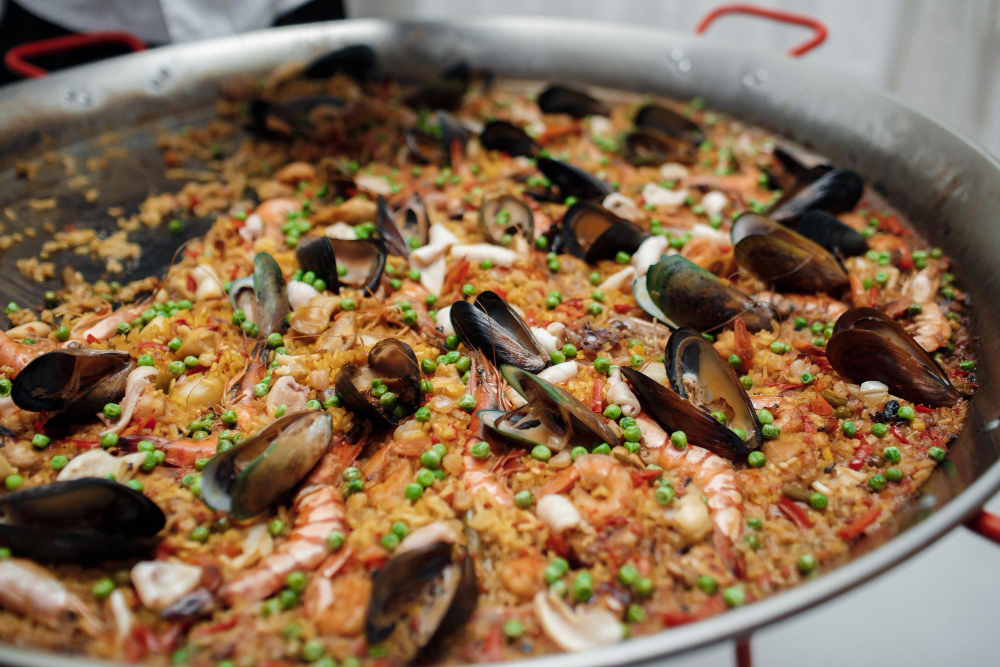
The seafood paella is built on a good fumet. In Barcelona, access to the Mediterranean usually means fresh shellfish and fish: prawns, squid, mussels and occasionally more noble crustaceans. The real difference is the stock — a proper fumet elevates the dish from pleasant to memorable. Ask whether the kitchen makes its stock in-house and where the seafood is sourced; this tells you more than the garnish.
HMixed and fideuà: practical and regional choices
The mixed paella (meat + seafood) is a pragmatic solution for groups with varying tastes, but it is not the historically “authentic” Valencian formula. Fideuà, made with short noodles instead of rice, is a coastal classic and a great companion dish in Barcelona. In our events we often offer fideuà alongside paella to broaden textures and include guests who prefer seafood in a different form.
Technical essentials: rice, sofrito, stock and the holy socarrat
Rice: the decision is technical, not aesthetic
For an authentic paella, the rice choice is technical. Bomba rice is our preferred option because it absorbs liquid well and resists breaking, which gives tolerance in event conditions where heat control varies. Senia and Bahía are also suitable. Avoid long-grain rice or risotto blends; they change the intended texture and release starch differently.
Sofrito and stock: flavor in layers
The sofrito (onion, tomato, garlic) is the aromatic heart of the dish. It’s not “adding” ingredients; it’s concentrating flavor. The stock must be hot when added: a cold addition shocks the process and alters texture. For seafood paella use a properly reduced fumet; for Valencian dishes a light poultry or vegetable stock will be the backbone. We avoid artificial enhancers — good technique renders them unnecessary.
Socarrat: the trick and the risk
The socarrat —that toasted crust on the pan’s bottom— is the signature of a skilled paellero. Technically it’s achieved with a short, intense burst of heat once most of the liquid has evaporated. The objective is caramelization without bitterness. On event days we use calibrated burners or paella grills with wind guards to control this final stage; timing and experienced judgment are decisive.
Where to find the best paella in Barcelona (practical signals)
Quality signals in a restaurant
When we look for a place that serves the best paella Barcelona offers, we check for:
- Explicit use of rice designed for paella (Bomba, Senia).
- Evidence of in-house stock preparation.
- Transparency about the origin of seafood and meats.
- Live cooking or at least an explanation of how the socarrat is achieved.
- Staff able to explain technique and provenance — if they can’t, the kitchen may be taking shortcuts.
Formats that work in Barcelona
- Seafront restaurants: they offer full spectacle and context, although wind and logistics demand extra precautions.
- Gastronomic markets: freshness and variety make them a safe path to good paella.
- Hands-on classes and workshops: ideal if you want to learn while eating; perfect for team-building scenarios.
- Catering and private events: highly flexible, but require prior checks on permits for open flame and venue rules.
How we organize paella competitions and tapas team-building (step-by-step)
Choosing the format: competitive vs collaborative
We design two main formats depending on client goals:
- Competitive: teams of 4–6 prepare paellas using identical kits and are judged on objective criteria — taste, rice texture, socarrat, presentation and teamwork. This format is excellent for incentive programs where performance and measurable outcomes matter.
- Collaborative: tasks rotate among team members (sofrito, stock, plating), and the result is shared. This reduces stress and focuses on communication and shared responsibility — ideal for culture-building.
A typical 3-hour timeline we use
- Welcome & briefing (20–30 min): rules, safety, judging criteria and roles.
- Mise en place (30–45 min): chopping, measuring and staging; allergen labelling is essential.
- Cooking phase (45–60 min): sofrito, searing proteins, adding rice and stock; we maintain a controlled heat curve.
- Socarrat & resting (10–15 min): heat spike and covered rest to let flavors consolidate.
- Tasting & judging (30–45 min): plated tasting, scoring and constructive feedback.
- Debrief & awards (10–20 min): photos, certificates and wrap-up.
Roles and staffing ratios
- 1 lead chef/facilitator per 2–3 teams for technical guidance and safety oversight.
- 1 runner per 2 teams for replenishment and troubleshooting.
- 1 food-safety coordinator per event to monitor cold chain, allergen zones and hygiene.
Operational checklist: equipment, permits and safety
Equipment by team
- Paella pan (50–65 cm for groups of 6), calibrated gas burner or paella grill, ladles and tongs.
- Pre-measured Bomba rice, labelled ingredient baskets, thermometers and PPE.
- First-aid kit and fire extinguisher within reach.
Permits and flame regulations
Many venues restrict open flame. We always confirm in writing whether the space allows gas burners; when flame is prohibited we use professional electric pans or central-kitchen prep with on-site finishing. Always check local regulations and insurance policies — this is non-negotiable for corporate events.
The coffee break as a tactical tool
Why we plan the coffee break with intention
In culinary events the coffee break is an operational fulcrum: it allows participants to regroup, cleans utensils and resets the workflow before tasting. We place it strategically — typically after initial cooking and either before the final socarrat stage or during the paella’s resting period.
- Timing: 15–25 minutes; long enough to refresh guests but short enough to maintain momentum.
- Offerings: espresso, decaf, herbal teas, still/sparkling water, a small pastry or fruit; include vegan and allergen-free options.
- Logistics: separate self-service station away from burners; compostable disposables if sustainability is a priority.
- Safety: hand-sanitiser points and signage to prevent cross-contamination.
Sustainability and responsible sourcing
Suppliers and certifications we recommend
We prioritise local, seasonal produce and, for seafood, MSC/ASC-certified suppliers whenever feasible. We keep traceability records and supplier documentation — essential for corporate transparency and potential audits.
Waste minimisation tactics we apply
- Pre-portioning ingredients to avoid leftovers.
- Reusing safely handled leftover stock for subsequent preparations when regulations allow.
- Setting up composting and recycling stations with clear signage for participants.
Extra value content: recipes, practical cases and comparisons
Operational paella recipe (8–10 people) — an executive summary
Key ingredients
- Bomba rice: pre-measured per person.
- Hot stock: fumet for seafood, light poultry/vegetable for Valencian.
- Proteins: chicken, rabbit or seafood depending on the variant.
- Vegetables: seasonal produce, beans or garrofó.
- Olive oil, garlic, tomato for the sofrito; saffron or smoked paprika sparingly.
Critical steps
- Build a concentrated sofrito.
- Sear proteins briefly to develop Maillard notes.
- Add rice and pour hot stock in one go; do not stir thereafter.
- Monitor evaporation and apply a heat spike to form socarrat.
- Rest covered for 5–7 minutes before serving.
For a full recipe with quantities and timings, consult our recipes.
Frequently Asked Questions (FAQs) — practical, authoritative answers
What distinguishes an authentic paella from a tourist version?
Authenticity resides in technique and provenance: the correct rice (Bomba or Senia), an in-house stock, a well-worked sofrito and an intentional socarrat. Tourist versions often prioritise volume and visual impact over precise technique — they may use mixed rice blends, commercial stocks or overcomplicated ingredient lists that mask the dish’s identity. Ask the kitchen where they source their rice and whether they make the fumet; if they answer clearly, that’s a strong indicator of quality.
Can we run a competition if some participants have allergies (e.g., shellfish)?
Yes, provided you design the event with allergen zones. We always establish separate stations or dedicated allergen-free teams, use distinct utensils and pans, and require producers to label ingredients clearly. Include allergen management in the initial briefing and provide ingredient cards to each team. A food-safety coordinator should oversee compliance.
How do you score a paella competition?
Our standard rubric weights: taste (40%), rice texture (25%), socarrat (15%), presentation (10%) and teamwork/hygiene (10%). Judges provide short, constructive comments. In corporate settings we emphasise positive feedback and learning, turning the judging into a growth moment rather than a punitive exercise.
What wine pairs best with paella?
It depends on the paella. For seafood paella we recommend cava or dry white wines; for mixed or Valencian paellas, rosé or a young red works well. Avoid highly tannic wines that overpower the rice. Always offer sparkling water and non-alcoholic pairings.
Do you need permits to cook paella outdoors in Barcelona?
Often, yes. Public spaces and some private venues require permits for open flame or for occupying municipal areas. We always confirm venue permissions in writing and prepare alternatives (electric pans, central-kitchen finishing) if flame use is restricted. Insurance and venue policy checks are part of our standard contracting process.
How long does it take to organise an event for 50 people?
Operationally, we recommend 3–6 weeks for sourcing venues, confirming permits and locking suppliers. On the event day, plan for a 3-hour window as described above. Short-notice events are possible but will limit venue options and require additional coordination.
Executive summary, final checklist and call to action
Paella in Barcelona is a social ritual that combines culinary technique with operational rigour. From a classic seafront restaurant to a well-executed corporate competition, success depends on three pillars: correct ingredients, precise heat control, and impeccable logistics. If you want to know where to eat paella, prioritise venues that are transparent about ingredients and technique; if you are planning an event, document permits, food-safety measures and a realistic timeline.
We always advise running a small class or workshop before a large event: it reduces risk, aligns expectations and gives your team a shared reference.
Final practical checklist (use this the day before the event):
- Confirm venue permissions for open flame or arrange electric alternatives.
- Verify supplier deliveries and traceability (seafood provenance, meat suppliers).
- Confirm staff assignments: lead chef(s), facilitators, runners, safety coordinator.
- Prepare printed judging rubrics and ingredient cards.
- Set up allergen-free stations and signage.
- Test burners and gas lines; have spare canisters and fire extinguishers on hand.
- Plan waste streams: compost, recycling and residuals.
- Confirm photographer/MC if you want documentation and social assets.
We craft events that honour the tradition of paella while delivering measurable engagement for teams and unforgettable culinary moments for guests.